How Substrate Doping Concentrations in Modern Chipsets Modulate Electron Mobility During Sustained Multi-Threaded Physics Simulations on Enthusiast Platforms
Elena Wolf · Sep 18, 2026
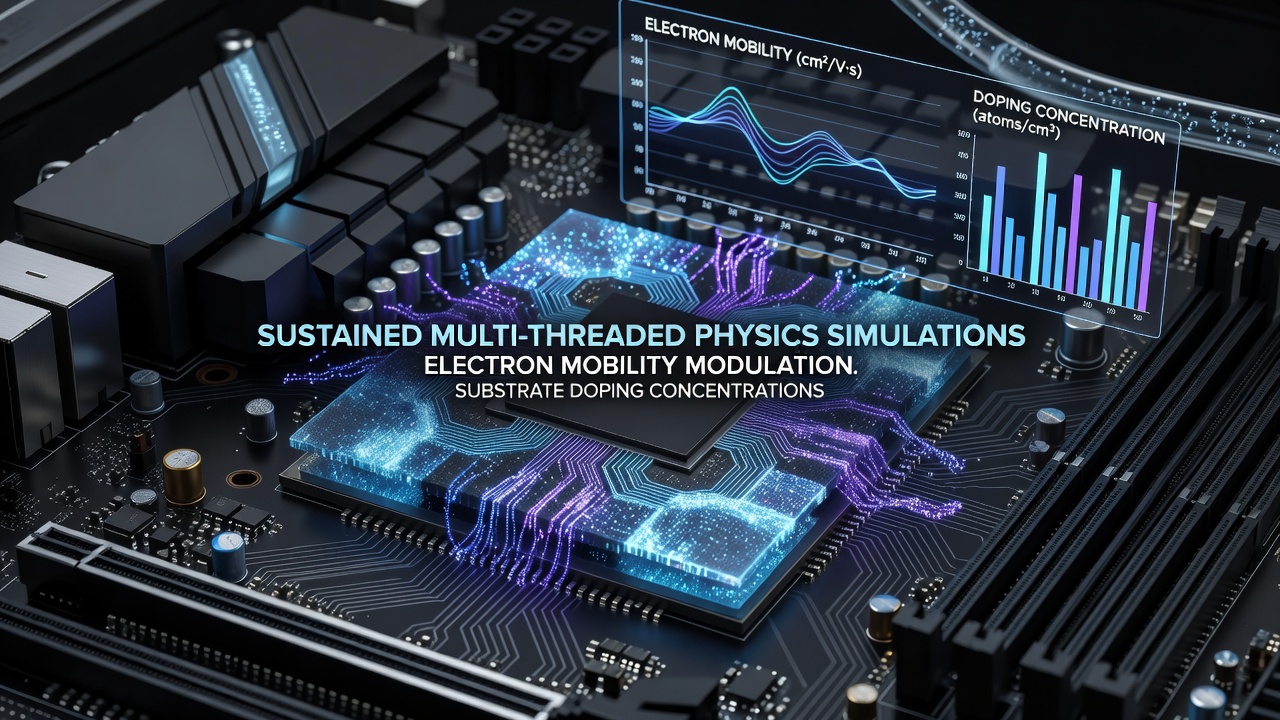
How Substrate Doping Concentrations in Modern Chipsets Modulate Electron Mobility During Sustained Multi-Threaded Physics Simulations on Enthusiast Platforms
Enthusiast platforms running sustained multi-threaded physics simulations place heavy demands on chipset materials, where substrate doping concentrations directly shape electron mobility through controlled introduction of impurities that alter carrier density and scattering rates. Higher doping levels increase the number of charge carriers available for conduction, yet they simultaneously create ionized impurity centers that scatter electrons and lower overall mobility, a trade-off documented across silicon and advanced node processes used in 2026 hardware. Engineers adjust dopant profiles during fabrication to balance these factors, ensuring stable operation when simulation workloads keep multiple cores at peak utilization for hours at a time.Fundamentals of Doping and Carrier Transport
Substrate doping begins with the addition of elements such as boron or phosphorus into the silicon lattice at concentrations typically ranging from 10^15 to 10^19 atoms per cubic centimeter, depending on the transistor region and process node. This process sets the baseline conductivity while influencing how electrons move under applied electric fields during computation. In n-type regions, donor atoms release electrons into the conduction band, whereas p-type regions rely on acceptor atoms that create holes; the resulting majority carrier type determines which mobility metric matters most under load. Data from semiconductor characterization studies show that electron mobility in lightly doped substrates can exceed 1400 cm²/V·s at room temperature, but values drop sharply once doping surpasses 10^17 cm⁻³ because Coulombic interactions intensify.
Physics simulation engines stress these materials by generating continuous streams of memory accesses and floating-point operations that keep voltage regulators and interconnects active. Sustained activity raises local temperatures, further modulating mobility since lattice vibrations add phonon scattering on top of impurity effects. Observers note that enthusiast motherboards with enhanced power delivery phases help maintain consistent voltage, which in turn keeps electric field strengths within ranges where doping-related mobility changes remain predictable rather than erratic.
Impact on Multi-Threaded Workloads
When multiple physics threads run concurrently, the chipset must handle rapid state changes across cache hierarchies and memory controllers. Elevated doping in specific layers can reduce series resistance in interconnects, allowing faster signal propagation, while overly aggressive concentrations increase leakage paths that become problematic once die temperatures climb above 80 °C. Research indicates that modern 5 nm and 3 nm nodes employ graded doping profiles, where surface concentrations differ from deeper substrate regions, to mitigate these competing influences during extended runs.
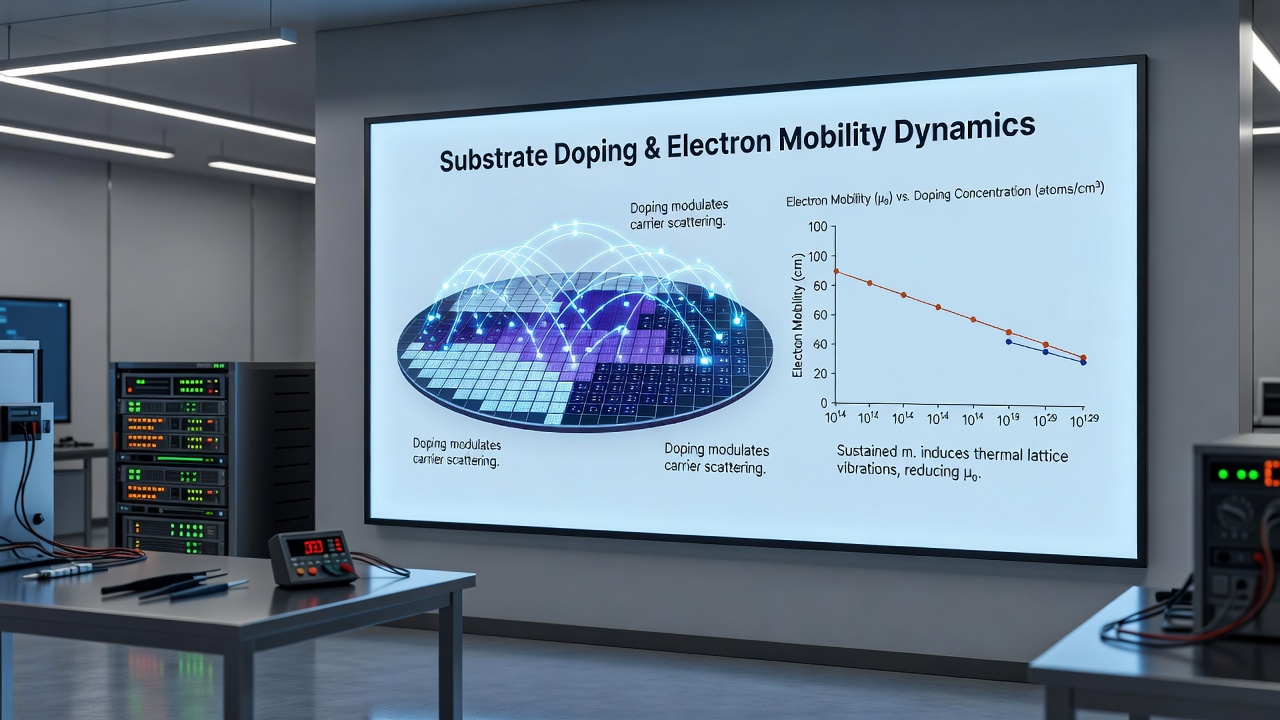
Case studies from overclocked systems reveal that platforms tuned for 24/7 simulation sessions often exhibit measurable mobility degradation after several hours, correlating with localized dopant activation changes induced by self-heating. Manufacturers counter this by incorporating strain engineering alongside doping adjustments, which alters band structure and partially offsets mobility loss. According to reports from the National Institute of Standards and Technology, precise metrology of these combined effects helps predict long-term behavior under continuous high-current conditions typical of enthusiast builds.
Thermal and Electrical Interactions in 2026 Hardware
By September 2026, many high-end chipsets integrate real-time telemetry that tracks both temperature and inferred mobility shifts, feeding data back to firmware for dynamic voltage adjustments. These mechanisms become relevant when physics engines spawn thousands of simultaneous rigid-body or fluid calculations that keep memory buses saturated. Lower doping near critical junctions can preserve higher mobility at the cost of higher resistivity, forcing designers to optimize layout so that current density remains below thresholds that accelerate electromigration.
European research consortia have published findings on similar nodes, highlighting how uniform doping distribution across large dies reduces variability in electron transport during parallel workloads. Such consistency matters when simulations run across multiple GPUs and CPUs linked through high-speed interconnects, because any mobility mismatch can introduce timing skews that manifest as frame-time variance.
Conclusion
Substrate doping concentrations therefore act as a fundamental control knob that modulates electron mobility through the interplay of carrier density, impurity scattering, and thermal effects, all of which become pronounced during sustained multi-threaded physics simulations on enthusiast platforms. Accurate modeling of these interactions supports continued scaling of simulation complexity without compromising stability. Continued refinement of doping techniques, paired with advanced cooling and power delivery, enables the hardware to sustain the performance levels demanded by current workloads.